Table of Contents
- What Are the Biggest Photography Trends Right Now?
- Wedding Photography Trends: Documentary Over Posed
- Commercial Photography Trends: Product, Fashion, and Real Estate
- TikTok and Instagram Photography Trends for 2026
- Photography Editing and Style Trends: From Film Grain to AI Tools
- Photography Business and Market Trends: What the Industry Shift Means for You
- Limitations and Common Mistakes: What These Trends Won’t Fix
- Frequently Asked Questions About Photography Trends
- Where Photography Is Heading — And What to Do Next
This blog post may contain affiliate links. As an Amazon Associate I earn from qualifying purchases.
You already know the feeling. You scroll past another long-exposure waterfall shot, perfectly sharp, silky smooth — and feel nothing. The photography trends that once felt exciting have started to look like wallpaper. Meanwhile, some photographers in your community are getting thousands of saves on work that looks almost unfinished — grainy, slightly blurry, shot on a point-and-shoot. What are they doing that you’re not?
The old playbook — HDR-processed skies, heavy presets, gear-heavy tutorials — is losing its grip on audiences. The photographers getting noticed in 2026 are working from a completely different set of instincts, one shaped by a cultural backlash against over-processed imagery that has been building for years. Current photography trends have shifted, and this guide maps exactly where they’ve landed.
Here, you’ll discover 15 photography trends shaping 2026 — and the exact steps to implement each one, whether you shoot weddings, products, or portraits. We cover everything from raw documentary styles and cinematic storytelling to TikTok-first composition and AI-assisted editing — so you can stop chasing every fad and start building a style that actually resonates.
Key Takeaways: Photography Trends 2026
The biggest photography trends for 2026 center on raw authenticity — a direct response to AI-saturation — alongside cinematic storytelling and mobile-first composition.
- The Authenticity Pendulum: Every AI perfection surge triggers equal demand for raw, imperfect imagery — the defining creative force of 2026
- Cinematic storytelling is the #1 trend: dramatic light, mood, and narrative captured in a single frame
- Documentary and candid styles are replacing posed, studio-perfect wedding photography as couples demand real moments
- TikTok-first framing (vertical, lo-fi) is reshaping how all photographers compose shots — not just social media creators
- AI editing tools save time on culling and retouching — but they cannot replace authentic human vision
What Are the Biggest Photography Trends Right Now?
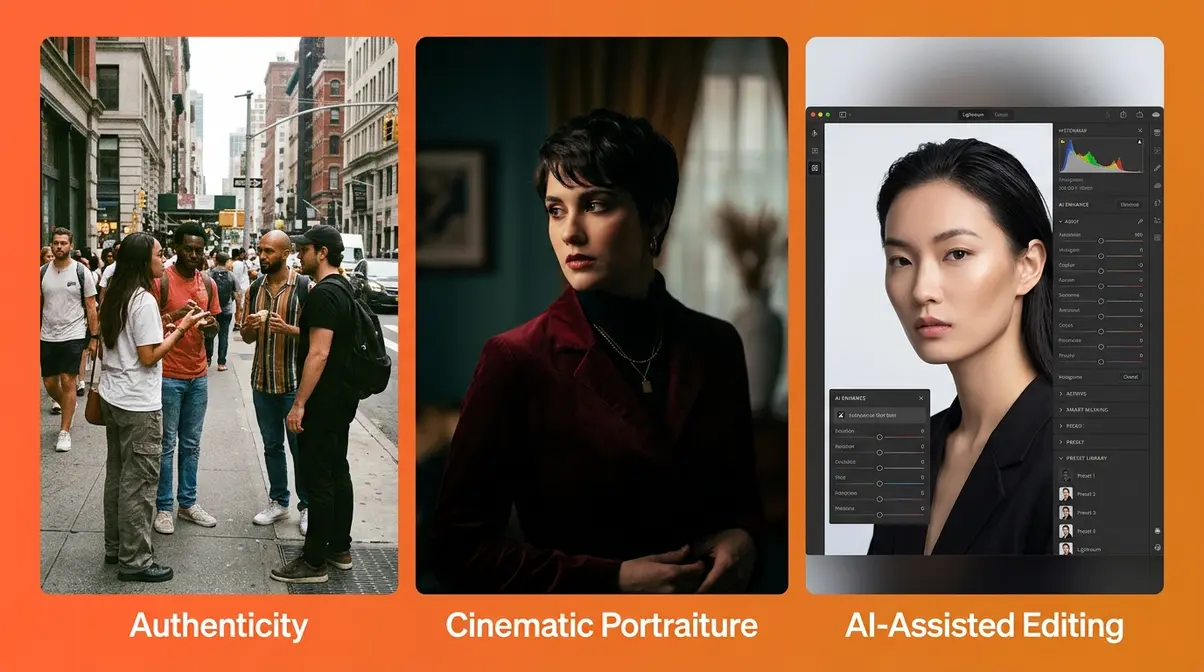
The biggest photography trends for 2026 are raw authenticity, cinematic storytelling, and AI-assisted editing — a trio that reflects a fundamental shift in what audiences value after years of hyper-processed imagery. Premium mirrorless camera sales are holding steady even as smartphone photography dominates, signaling a deliberate move toward quality and intentionality (Statista, 2025). If your shots still rely on heavy presets and dramatic HDR, what follows shows you exactly what to swap in instead.
These three universal trends are also the best entry point for understanding why 2026 photography looks the way it does — before diving into niche-specific techniques for weddings, commercial work, and social media.
The Authenticity Pendulum: Why Raw Beats Polished in 2026
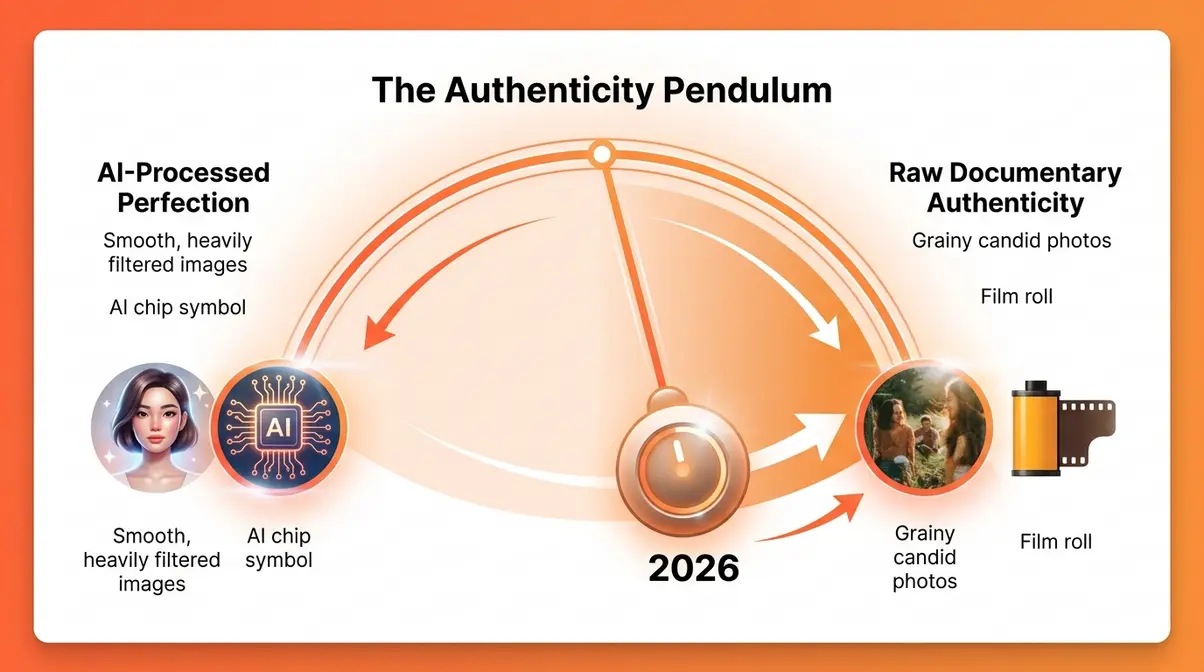
The Authenticity Pendulum — a framework we use at amateurphotographerguide.com to describe the cyclical push-pull between AI-driven perfection and raw human imagery — is the single most important concept for understanding 2026 photography trends. Every time AI-generated or over-processed imagery floods a platform, audiences swing hard in the opposite direction. They start craving photos that feel made by a human, with all the imperfection that implies.
This frustration has been building for years in photography communities. The sentiment is real and widespread:
“Long exposure waterfalls or cascades, you’ve seen one you’ve seen them all.”
That’s not cynicism — it’s market feedback. When a style becomes so reproducible that anyone with a tripod and a Preset can nail it, the style loses its power. The Reuters Trust Principles make this institutional: major news organizations now formally prohibit heavily manipulated imagery, establishing authenticity as a professional standard, not just an aesthetic preference (Reuters, 2024). If the world’s most trusted image-makers are drawing a line against over-processing, audiences are noticing — and responding.
Importantly, “authentic” doesn’t mean sloppy. It means intentional imperfection: slight grain left in the image, natural shadows that aren’t filled, unposed moments caught mid-breath. The difference between a raw photo that works and one that doesn’t is intention — you’re choosing the imperfection, not stumbling into it. That’s a skill worth developing, and it starts with exploring key photography trends from 2025 to see how this shift has been building.
Try This Today:
1. Shoot one subject entirely in natural light — no fill flash, no reflector.
2. Resist the urge to remove grain in post-processing.
3. Post the result and note the engagement difference compared to your processed work.
Cinematic Storytelling: Make Every Shot Feel Like a Movie Still
Cinematic storytelling is the top photography trend for 2026 among semi-professional photographers, and it’s one of the most learnable skills on this list. A cinematic photo feels like a still from a film — it has dramatic lighting, a clear emotional mood, and a sense that something is about to happen or just did.
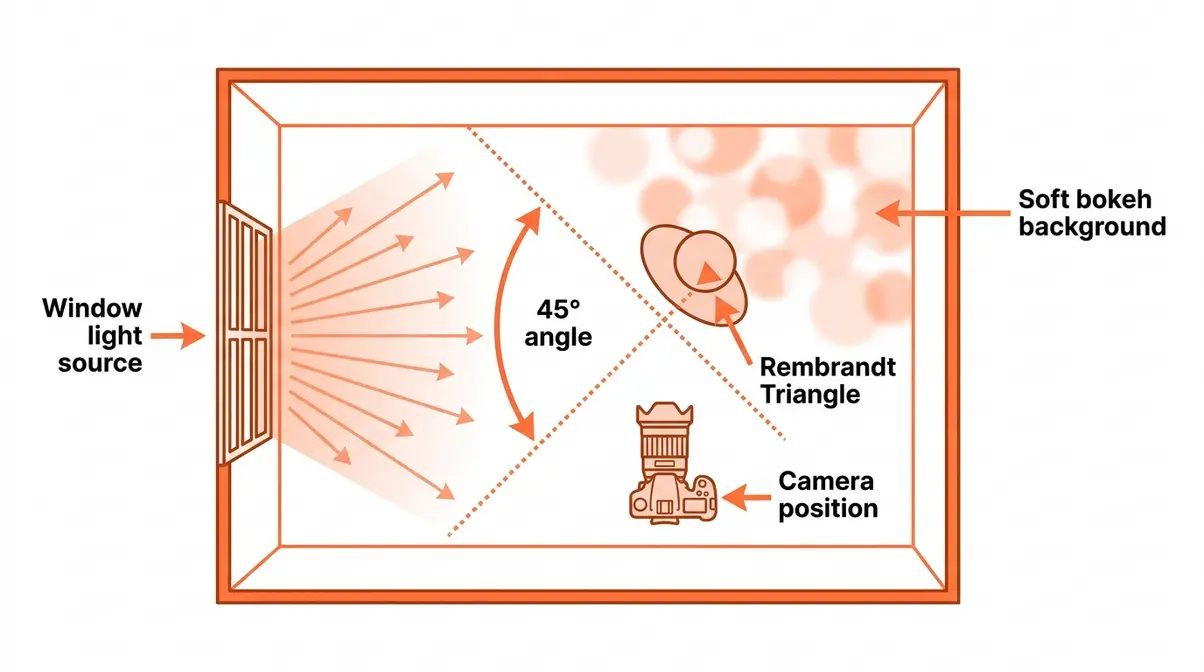
The technique hinges on two concepts you’ll want to understand. Rembrandt light is side-lighting that creates a small triangle of illumination on the subject’s cheek — it adds depth and drama without any special gear, just a window. Bokeh (the soft blur behind your subject) separates your subject from the background, drawing the eye exactly where you want it.
Here’s a beginner-friendly, step-by-step approach to the cinematic look:
- Position your subject near a window or a single light source, angled at roughly 45° to their face.
- Set your aperture to f/1.8–f/2.8 to achieve that background blur (bokeh).
- Slightly underexpose by -0.7 stops — this creates a moodier, more atmospheric feel.
- In editing, lift the shadows slightly (+15) and reduce highlights (-30) to mimic the look of a film print.
The counter-narrative worth knowing: cinematic framing doesn’t suit every situation. High-energy events — concerts, street photography, sports — often look far more powerful with a faster shutter speed and harsher, more direct flash. The skill is knowing when to deploy the cinematic approach, not applying it to everything. Try a portrait of a friend reading near a window at dusk — that single scenario teaches all four cinematic techniques simultaneously.
Try This Today:
1. Find a single window light source at dusk or on an overcast day.
2. Set your aperture to f/2 or lower.
3. Underexpose by -0.7 stops and compare the result to your last flash-lit portrait.
AI-Assisted Editing: Efficiency Tool, Not Replacement
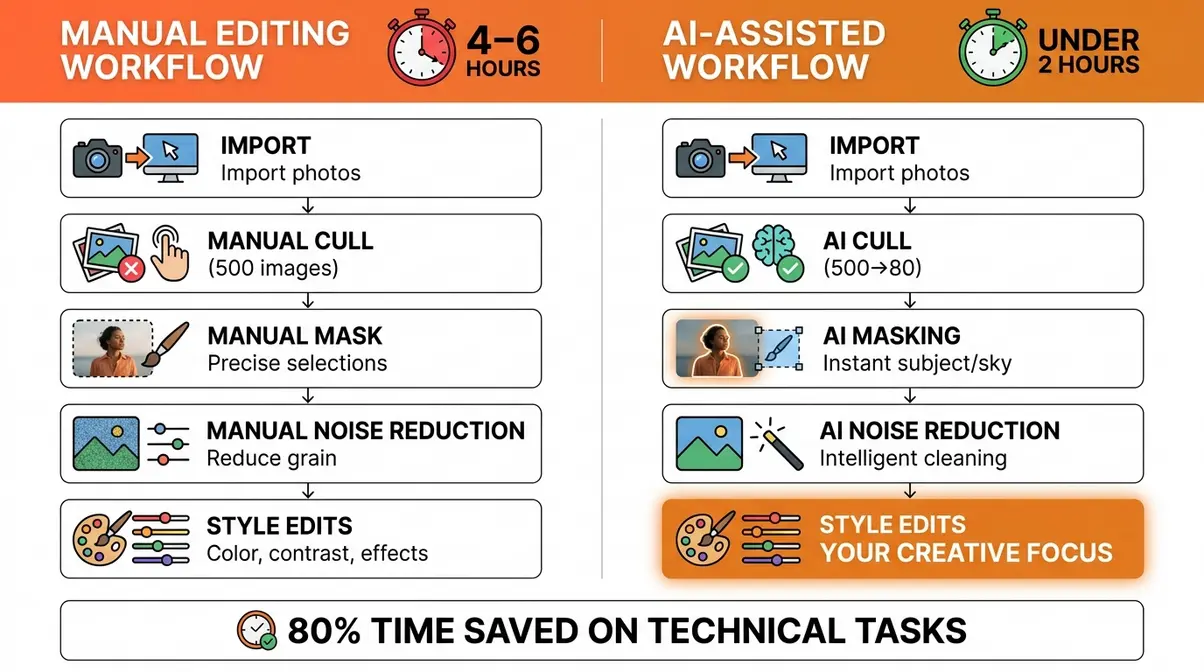
Among current photography trends, AI-assisted editing is the most misunderstood. There’s an important distinction to draw: AI generation (creating images from text prompts — ethically complex and legally contested) versus AI editing assistance (culling, masking, noise reduction — already standard in professional workflows). The 2026 trend is firmly the latter.
Tools like Adobe Lightroom’s AI Masking automatically select skies, subjects, and backgrounds in seconds. Topaz DeNoise AI removes grain without destroying texture. Apps like After Shoot or Narrative Select can reduce a 500-shot wedding to 80 selects in under 10 minutes. That’s not replacing your creative vision — it’s protecting your time so you can exercise it.
The legal dimension matters here. WIPO analysis on AI and photography copyright confirms that ongoing legal challenges regarding copyright in the age of generative AI are pushing photographers to document their creative process to maintain IP rights (WIPO, 2024). Practically, this means keeping your original RAW files, noting your locations and camera settings, and being able to demonstrate that a human made the creative decisions. This is increasingly important for professional credibility — and it’s a habit worth building now.
Think of this as the 80/20 rule applied to editing: AI handles 80% of the repetitive technical work (culling, masking, noise reduction) so you can focus on the 20% that defines your style — color choices, crop decisions, the emotional arc of a gallery.
Try This Today:
1. Import your last shoot into Adobe Lightroom.
2. Use “AI Masking > Select Subject” to isolate your main subject.
3. Adjust the subject and background independently — note how much time you saved versus manual masking.
The Authenticity Pendulum plays out differently in every photography niche. Nowhere is the shift from polished to raw more dramatic than in wedding photography.
Wedding Photography Trends: Documentary Over Posed
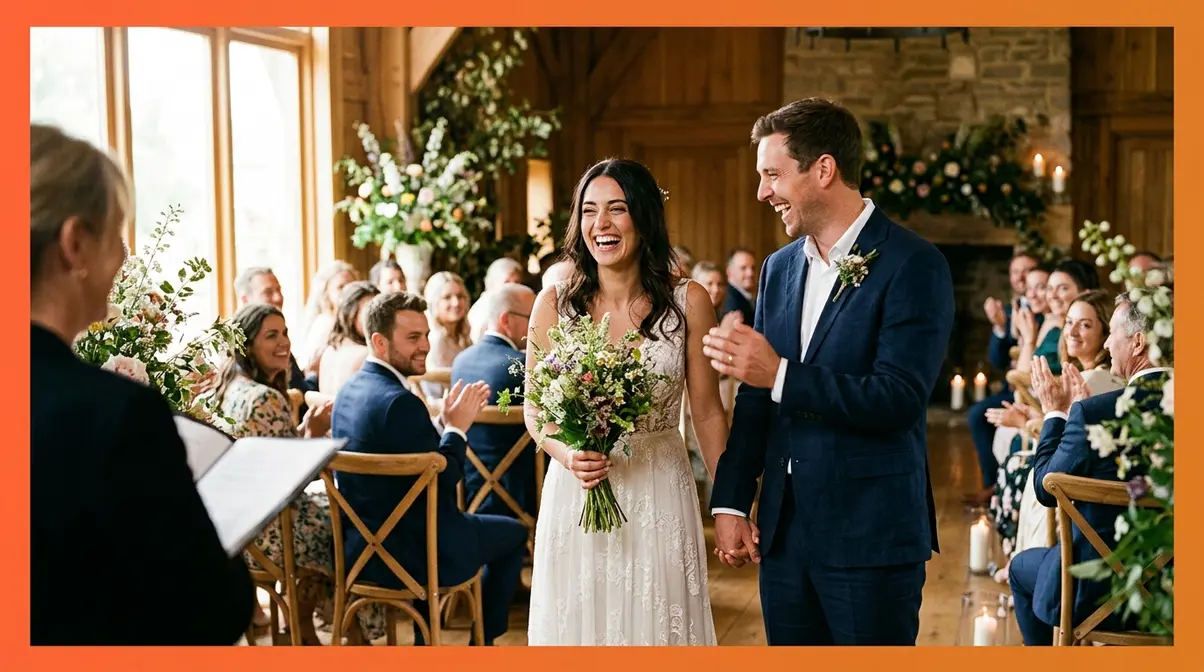
The three most important wedding photography trends for 2026 are: (1) documentary/candid shooting, (2) film emulation with grain and warm tones, and (3) the direct flash “paparazzi” aesthetic. Each represents a rejection of the over-lit, perfectly posed wedding album — and a move toward images that feel genuinely lived-in. This is the Authenticity Pendulum in its most commercially visible form: couples are now explicitly requesting real over perfect when they brief their photographers.
Documentary and Candid Shooting: Capturing Real Moments
Documentary wedding photography — a style borrowed from photojournalism that prioritizes real moments over staged poses — is the most-requested style shift among couples booking photographers for 2026. The approach means working like a photojournalist: anticipating moments rather than directing them.
Practically, this starts before you even pick up the camera. Arrive 60 minutes early to map the venue’s best natural light pockets — the window at the end of the hallway, the open barn door, the garden corner that gets soft afternoon light. For lenses, a 35mm or 50mm focal length mimics natural human vision, making subjects feel “present” in the frame rather than compressed or distant.
Camera settings that produce natural-looking candid shots: shoot in burst mode (continuous shooting), use Auto ISO capped at 3200 for indoor reception light, and keep your shutter speed at a minimum of 1/250s to freeze natural movement without blur.
What to tell clients: “I’ll be a fly on the wall — you won’t notice me, but I’ll catch every real moment.” That single sentence sets expectations and dramatically reduces staged-pose requests throughout the day.
Try This Today:
1. At your next shoot, spend the first 10 minutes without taking a single posed shot.
2. Observe, anticipate, and wait for moments to unfold naturally.
3. Compare those images against your posed work — note which feel more alive.
Once you’ve captured raw moments, the editing phase can transform those images into something timeless — which is where film emulation comes in.
Film Emulation and the Grainy, Vintage Look
Film emulation means applying digital presets or editing adjustments that mimic the look of specific analog film stocks. The two most requested in wedding photography right now are Kodak Portra 400 (warm, slightly desaturated skin tones with excellent shadow detail) and Fuji 400H (cooler, more pastel, with lifted blacks). Tools that deliver these looks include VSCO, Mastin Labs presets, and Lightroom’s built-in film simulation profiles.
Here’s a step-by-step process to build the film emulation look from scratch:
- Reduce global saturation by -10 to -15 in your HSL panel.
- Add grain via Lightroom’s Detail panel — set Amount to 20–30, Size to 25, Roughness to 50.
- Pull highlights down to -30 to prevent blown-out skin tones.
- Lift blacks slightly to +10 for that characteristic “faded” film look.
- Add a subtle split-tone: warm orange in the shadows, soft yellow in the highlights.
The “blurry Boca” (bokeh) effect pairs naturally with film emulation — soft background blur combined with grain is the most-requested aesthetic combination in wedding photography for 2026. Together, they signal warmth, intimacy, and a sense of time passing — exactly what couples want when they look back at their images years later.
Try This Today:
1. Apply a VSCO “A4” or “A6” preset to a recent portrait.
2. Reduce the preset strength to 70% so it reads as subtle.
3. Add 25 grain in Lightroom’s Detail panel and compare to your standard edit.
Film emulation handles the soft, romantic side of wedding photography. For receptions and dance floors, a completely different — and surprisingly bold — trend is taking over.
Direct Flash and the ‘Paparazzi’ Aesthetic
The direct flash aesthetic is the most contrarian wedding photography trend of 2026 — and one of the most effective for reception and dance floor coverage. The technique uses a bare on-camera speedlight (no diffuser, no bounce card) pointed directly at the subject, creating stark shadows behind them. It looks exactly like a celebrity being photographed at a party. That’s intentional.
What you’ll need: Any speedlight — the Canon 600EX, Nikon SB-700, and Godox V860III are all widely used. Set the flash to TTL mode (automatic exposure calculation) and point it straight forward. Camera settings: 1/200s shutter speed, f/5.6 aperture, ISO 400.
The “imperfect” harshness of direct flash reads as more real and energetic than softbox-diffused reception photography. This is the Authenticity Pendulum operating at its most visceral — the technically “wrong” choice produces the emotionally “right” result because it matches how people actually experience a party: bright, fast, slightly chaotic, and alive.
What to tell clients: “The dance floor shots will have that bold, editorial flash look — think Vogue party pages, not traditional reception albums.” Setting this expectation in advance converts potential objections into excitement.
Try This Today:
1. Remove your flash diffuser entirely.
2. Point the flash directly at your subject — no bounce.
3. Shoot 5 frames and compare the energy to your usual bounced-flash reception shots.
The documentary and authentic principles driving wedding photography are equally reshaping commercial work — though the specific techniques look quite different for product, fashion, and real estate photographers.
Commercial Photography Trends: Product, Fashion, and Real Estate

The three dominant commercial photography trends for 2026 are: (1) minimalism and lifestyle integration in product photography, (2) surrealism meets authentic casting in fashion, and (3) virtual staging and environmental storytelling in real estate. Clients across all three niches are rejecting stock-photo perfection — the same Authenticity Pendulum that’s reshaping wedding work is pushing commercial clients toward imagery that feels contextual and human.
Product Photography: Minimalism and Lifestyle Integration
Minimalist product photography — a style that isolates the product on clean backgrounds to let quality speak for itself — has evolved in 2026 to include lifestyle integration: the product shown in actual use, in real environments, by real-looking people. The shift reflects what e-commerce data consistently shows: lifestyle product images outperform pure white-background shots in click-through and conversion rates (Printful, 2025).
For photographers hopping on this trend, the practical approach combines both: a clean hero shot (white or neutral background, controlled lighting) paired with two to three lifestyle shots (product in use, natural environment, real hands). Lighting setup for the hero shot: two softboxes at 45° angles, one slightly brighter than the other to create subtle shadow depth.
What to tell clients: “We’ll shoot the clean catalog version and the lifestyle version in the same session — you get both audiences covered.” This positions you as a strategic partner, not just a technician.
Try This Today:
1. Pick any household product and shoot it on a clean white surface with a single window light.
2. Then shoot the same product in natural use — held, worn, or in context.
3. Compare engagement when posted separately.
Fashion Photography: Surrealism Meets Authentic Casting
Fashion photography in 2026 is pulling in two directions simultaneously — and the tension is productive. On one side: surrealism, mixed media, and digitally composited environments that blur the line between photography and digital art. On the other: a push toward authentic casting — models and subjects who reflect real bodies, ages, and backgrounds rather than a narrow ideal. Fashion industry leaders at Vogue highlight a movement toward surrealism and mixed media, where traditional portraiture blends with digital art for 2026 campaigns (Vogue, 2025).
For semi-professional fashion photographers, the accessible entry point is authentic casting. Shoot real people from your community — friends, local creatives, small business owners — with intentional styling and strong light. The contrast between “real” subjects and high-production technique is exactly what makes this trend visually compelling.
For the surrealist side: double exposure (blending two images in-camera or in Photoshop), intentional lens flare, and environmental compositing (placing a subject in an unexpected context) are all techniques within reach of a beginner with patience and a Photoshop subscription.
Try This Today:
1. Cast a non-model friend for a fashion-style portrait session.
2. Focus on strong styling (one bold clothing choice) and dramatic window light.
3. Note how “authentic” subjects respond differently on camera than trained models — and how that difference reads in the final image.
Real Estate and Portrait Photography: What’s Shifting
Two niches that rarely appear in the same conversation are both undergoing significant changes in 2026. Real estate photography is integrating virtual staging (digitally furnished empty rooms using tools like BoxBrownie or Virtual Staging AI) with traditional architectural shots, giving photographers an additional service to offer without additional equipment. Drone shots paired with interior walkthroughs are now a baseline client expectation in most markets, not a premium add-on.
Portrait photography is shifting toward environmental portraits — subjects photographed in meaningful locations (their studio, their garden, their workplace) rather than against plain backdrops. This approach tells a story and aligns with the broader authenticity trend. Practically: scout your subject’s environment before the shoot, identify the best light pocket in their space, and use it as your primary setting.
What to tell portrait clients: “I want to photograph you somewhere that feels like you — your space, your context. It’ll show in the images.” This positions environmental portraiture as a premium, personalized service rather than a budget option.
Try This Today:
1. For your next portrait booking, ask the client to name their favorite room in their home or their workplace.
2. Schedule a 10-minute pre-shoot scout to find the best natural light in that space.
3. Shoot there instead of your usual backdrop setup and compare client reactions.
TikTok and Instagram Photography Trends for 2026
Social media platforms are no longer just distribution channels for photographers — they’re actively shaping how images are composed, cropped, and color-graded before a single photo is taken. Two photography trends dominate this space in 2026: vertical-first composition and the Gen Z lo-fi aesthetic.
Vertical Framing and Mobile-First Composition
Vertical framing — composing images in a 9:16 ratio (the dimensions of a phone screen held upright) rather than the traditional 3:2 or 4:3 — is now a fundamental composition skill for any photographer sharing work online. According to data from social media analytics platforms, vertical content receives significantly higher reach and engagement on both Instagram Reels and TikTok compared to landscape or square formats (Envato Elements, 2025).
The practical shift for photographers: when shooting, frame for both. Capture your standard horizontal composition, then reframe vertically — keeping the subject in the upper two-thirds of the frame so text overlays (common on TikTok) don’t obscure faces. On a full-frame camera, shooting at 24mm or wider gives you enough image data to crop to 9:16 in post without losing resolution.
Mobile-first composition also means thinking about how images look on a 6-inch screen at arm’s length — fine detail gets lost, bold contrast and strong subject separation matter more. This is one of the reasons the bokeh-heavy, high-contrast aesthetic is thriving: it reads immediately on mobile.
Try This Today:
1. On your next shoot, take every shot in both horizontal and vertical framing.
2. Post each version to your Instagram Stories vs. your feed and track which gets more engagement.
3. Adjust your default framing instinct based on what you see.
Gen Z Aesthetics: Photo Dumps, Lo-Fi, and Point-and-Shoot Revival
Among photography trends with the fastest-growing adoption rate, the Gen Z lo-fi aesthetic stands out for how deliberately it rejects technical perfection. Photo dumps — casual, unedited or lightly edited collections of images posted together — signal authenticity precisely because they don’t look curated. The Pew Research Center notes that Gen Z (born 1997–2012) now represents a dominant consumer force with distinct media preferences that prioritize realness over polish (Pew Research Center, 2024).
The point-and-shoot camera revival is the hardware expression of this trend. Compact film cameras (Canon Sure Shot, Olympus Stylus) and digital point-and-shoots from the early 2000s (Canon PowerShot, Sony Cyber-shot) are selling at a premium on eBay and Depop because their limitations — fixed focal lengths, automatic flash, slight barrel distortion — produce images that feel genuinely analog and human. You don’t need to buy vintage gear to capture this aesthetic, though: shooting in JPEG (not RAW), using your camera’s built-in flash on Auto, and skipping your usual preset workflow produces a similar result.
The lo-fi trend is color hunting in its purest form — finding visual interest in everyday, overlooked moments rather than constructed scenes. A blurry candid of friends at a table, a slightly overexposed sunset through a car window, a grainy self-portrait photographer moment in a bathroom mirror. These images get saved and reshared because they feel relatable, not aspirational.
Try This Today:
1. Shoot an entire day’s worth of casual moments on your phone’s native camera — no editing apps.
2. Post 6–8 images as a carousel without any preset or filter.
3. Note the response compared to your usual edited posts.
Photography Editing and Style Trends: From Film Grain to AI Tools
How you edit your photos is as much a part of your style as how you shoot them. The editing trends of 2026 reflect the Authenticity Pendulum directly: moody, restrained color grading is replacing the saturated, high-contrast Presets that dominated the 2018–2022 era.
Moody and Desaturated Tones: How to Nail the Look
Moody, desaturated editing — pulling color back toward neutrals while lifting shadows and compressing highlights — is the dominant editing style in professional photography for 2026. It reads as cinematic, intentional, and modern. The style works across genres: wedding, portrait, commercial, and street photography all benefit from it.
Here’s how to build the moody desaturated look in Lightroom:
- Reduce overall Vibrance by -15 (this desaturates less-dominant colors without killing skin tones).
- Drop Highlights to -40 and lift Shadows to +20 — this “compresses” the tonal range, mimicking the look of print film.
- In the Tone Curve, pull the top-right point (highlights) slightly down and push the bottom-left point (shadows) slightly up — this creates the “S-curve fade” that defines the look.
- In HSL, reduce Orange saturation by -10 (skin tones become more muted and natural).
- Add a subtle cool tint to shadows via the Color Grading panel — Hue 220 (blue), Saturation 10–15.
The result should feel like a photo taken on an overcast day with beautiful diffused light — calm, controlled, and emotionally resonant. The key mistake to avoid: going so far with desaturation that the image looks grey and lifeless. Pull back to 70% of your first instinct.
Try This Today:
1. Open a recent portrait in Lightroom and drop Vibrance to -15.
2. Pull Highlights to -40 and lift Shadows to +20.
3. Compare to your original — notice how the mood shifts without losing detail.
Presets vs. Custom Editing: Finding Your Signature Style
The Preset debate is one of the most emotionally charged conversations in photography communities — and it’s worth resolving clearly. Presets (pre-saved editing configurations that apply a consistent look to any image with one click) are not cheating. They’re a starting point. The photographers who are taking the win with their editing in 2026 are using presets as a base and then customizing 20–30% of the settings for each individual image.
The problem with relying entirely on a Preset is what experienced photographers call “Overprocessed HDR syndrome” — images that have a technically impressive look but feel emotionally hollow because every photo in a gallery looks identical regardless of the light, mood, or subject. Your signature style should be recognizable across your portfolio, but it should also breathe — adapting to each scene.
A practical framework for building a custom style:
- Start with a purchased or downloaded preset that roughly matches your aesthetic direction.
- Apply it to 20 different images from different lighting conditions.
- Note which settings consistently need adjustment (usually: exposure, white balance, skin tone saturation).
- Save those adjustments as your modified base preset — that’s now your starting point, not the original.
- Repeat this process after every 100 shoots. Your style evolves; your preset should too.
Among current photography trends in editing, the move away from Gear Review Overload (obsessing over which editing software is “best”) and toward process mastery is significant. Lightroom, Capture One, and Darktable all produce excellent results — the tool matters far less than the consistency of your approach.
Try This Today:
1. Pick your most-used preset and apply it to 10 recent images from different shoots.
2. Identify the one setting that always needs manual correction (usually white balance or exposure).
3. Bake that correction into the preset and save it as “My Base” — you’ve just started building a signature style.
Photography Business and Market Trends: What the Industry Shift Means for You
The business side of photography is changing faster than the creative side — and understanding these shifts gives you a significant advantage. Two trends define the market in 2026: AI’s reshaping of income streams, and the growing client demand for sustainable and ethical practices.
How AI is Reshaping Photography Careers and Income Streams
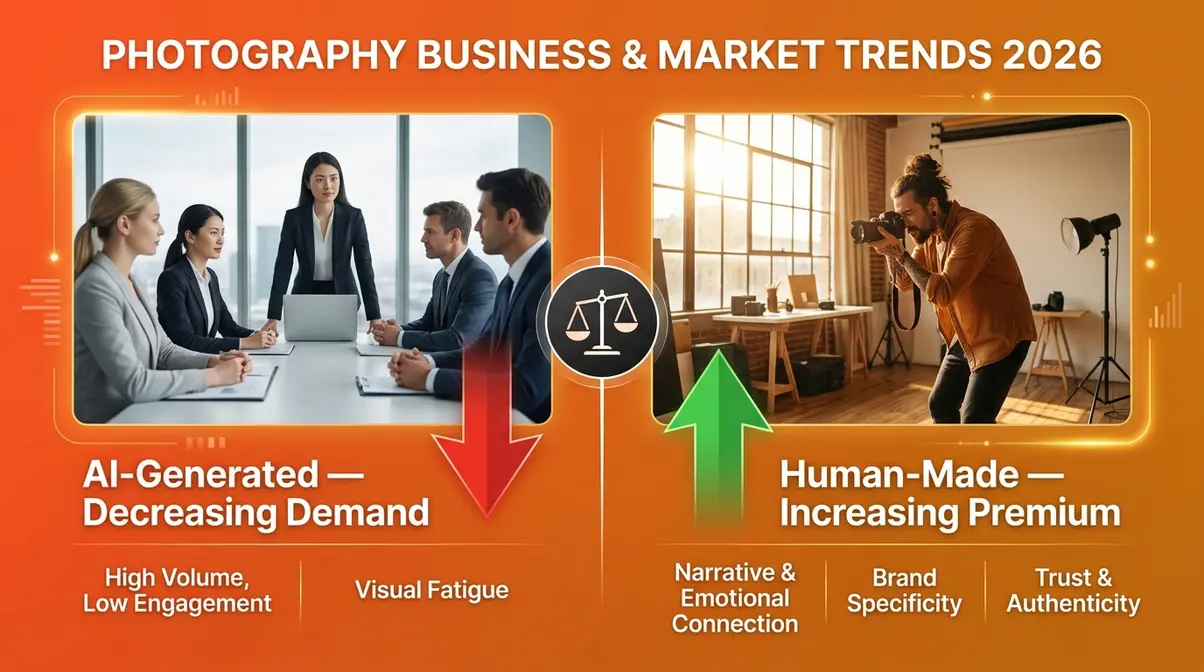
AI’s impact on photography careers is real, measurable, and nuanced. Stock photography platforms are seeing reduced demand for generic imagery (which AI can generate cheaply) while simultaneously seeing increased demand for authentic, context-specific, human-made photography that AI cannot replicate (Lummi.ai, 2025). The photographers feeling the most pressure are those whose work was already generic — the ones most easily replaced are the ones who weren’t building a distinctive voice.
WIPO analysis on AI and photography copyright confirms that legal frameworks for AI-generated imagery remain unresolved globally, creating a credibility premium for photographers who can demonstrate human authorship (WIPO, 2024). This is an opportunity: document your process publicly — behind-the-scenes content, location scouts, camera settings shared in captions — and your human-made work becomes more valuable, not less.
New income streams emerging for photographers in 2026: AI prompt consulting (helping brands brief AI image tools effectively), photography education content (YouTube, Substack, Patreon), and licensing authentic imagery to brands that specifically need human-made photography for trust-sensitive contexts (healthcare, journalism, legal).
“Photographers who build a recognizable, authentic visual voice are the least replaceable by AI — and the most sought-after by brands that need human credibility.” This is the business case for everything in this guide.
Try This Today:
1. Review your last 20 portfolio images — how many could be replicated by an AI image generator?
2. Identify the 5 images that couldn’t be — what makes them distinctly human and contextual?
3. Build your next 3 shoots around replicating those 5 images’ qualities intentionally.
Sustainable Practices and Ethical Photography
Sustainable photography — reducing the environmental and social impact of your creative practice — is moving from a niche concern to a client-facing differentiator in 2026. Brands with ESG (Environmental, Social, and Governance) commitments are increasingly asking photographers about their practices before booking. This is a business trend as much as an ethical one.
Practical sustainable practices for photographers:
- Digital delivery only — eliminate printed proof books and physical media. Platforms like Pixieset, ShootProof, and CloudSpot handle client galleries entirely online.
- Local casting and locations — reducing travel by working with local talent and nearby venues cuts both costs and carbon footprint.
- Equipment longevity over Gear Review Overload — buying one well-maintained camera body and two quality lenses outperforms cycling through gear every 18 months, both financially and environmentally.
- Ethical subject consent — especially relevant for street, documentary, and travel photography. Using clear consent processes protects subjects and builds professional reputation.
What to tell clients: “I operate a low-footprint studio — digital delivery, local talent, and long-term equipment relationships. If sustainability matters to your brand, we’re aligned.”
Try This Today:
1. Switch your next client delivery entirely to an online gallery platform (Pixieset has a free tier).
2. Note the time saved compared to preparing physical media.
3. Add “digital delivery” to your booking confirmation language as a sustainability feature.
Limitations and Common Mistakes: What These Trends Won’t Fix
Common Pitfalls to Avoid
Understanding photography trends is useful — but applying them without awareness of their limits leads to new versions of the same problem: work that looks like everyone else’s, just in a different style.
Pitfall 1: Chasing every trend simultaneously. Hopping on every trend at once produces an incoherent portfolio. Pick two or three trends that align with your existing strengths and niche, and master those before adding more. The photographers building strong followings in 2026 are focused, not omnivorous.
Pitfall 2: Confusing “authentic” with “unedited.” The authenticity trend doesn’t mean skipping post-processing — it means making editing choices that serve the image’s emotional truth rather than demonstrating software capability. A heavily edited image can feel authentic; an unedited image can feel lazy. Intention is the differentiator.
Pitfall 3: Applying lo-fi aesthetics to contexts that require polish. A point-and-shoot aesthetic works for personal social media and editorial content — it does not work for corporate headshots, real estate listings, or product photography where clients are paying for technical quality. Know your context before choosing your aesthetic.
Pitfall 4: Over-relying on AI editing tools without building foundational skills. AI masking and culling tools are powerful — but if you don’t understand why an edit works, you can’t troubleshoot when it doesn’t. Build manual editing skills first; use AI tools to accelerate a process you already understand.
When to Choose a Different Approach
These 15 trends represent the current direction of photography — they are not universal prescriptions. If your niche is scientific or technical photography (microscopy, forensic, architectural documentation), authenticity aesthetics and film emulation are actively counterproductive. If you shoot for clients who require brand consistency across thousands of images, a signature “imperfect” style creates quality control problems.
The most useful question isn’t “which trend should I follow?” but “which trends align with what my clients value and what I genuinely enjoy making?” That intersection is where sustainable creative development happens.
When to Seek Expert Help
If you’re considering pivoting your commercial photography business based on these trends, a one-session consultation with a photography business coach or a working photographer in your target niche is worth the investment. Trends observed at the industry level don’t always play out identically in regional markets — a wedding photography trend dominating New York may take 18 months to reach smaller markets, or may never arrive at all.
Frequently Asked Questions About Photography Trends
What are the new trends in photography?
The newest photography trends for 2026 center on raw authenticity, cinematic storytelling, and AI-assisted editing. Documentary-style shooting — prioritizing unposed, real moments — is growing across wedding, portrait, and commercial niches. Film emulation (recreating analog grain and color in digital editing) is the most-requested aesthetic in wedding photography. Mobile-first vertical framing is reshaping how all photographers compose for social media distribution. These trends collectively reflect a cultural backlash against over-processed, AI-saturated imagery.
What is the top photography trend in 2026?
Cinematic storytelling is the top photography trend in 2026 among semi-professional photographers. It combines dramatic side-lighting (Rembrandt light), shallow depth of field (bokeh — soft background blur), and deliberate underexposure to create images that feel like stills from a film. The technique is learnable with any camera that allows manual aperture control. Set your aperture to f/1.8–f/2.8, position your subject near a single window light at 45°, and underexpose by -0.7 stops as a starting point.
What is the 80/20 rule in photography?
**The 80/20 rule in photography** means that 80% of your results come from 20% of your decisions — most often applied to editing and shooting efficiency. In a 2026 AI-assisted workflow, it means letting AI tools handle 80% of repetitive tasks (culling, masking, noise reduction) so you can invest your creative energy in the 20% that defines your style: color choices, compositional decisions, and the emotional arc of a gallery. For shooting, it also means 80% of your strongest images typically come from 20% of your locations and lighting setups — master those before diversifying.
What are the 7 basics of photography?
The 7 basics of photography are: (1) Exposure — the total light hitting your sensor, controlled by aperture, shutter speed, and ISO; (2) Aperture (f-stop) — controls depth of field and light volume; (3) Shutter speed — controls motion blur and light duration; (4) ISO — sensor sensitivity to light (higher ISO = more grain); (5) Composition — how elements are arranged in the frame; (6) Lighting — the quality, direction, and color of your light source; (7) Focus — what’s sharp in the image. Mastering these seven elements gives you creative control over every photography trend discussed in this guide.
What is Michael Anthony’s photography style?
Michael Anthony is a wedding photographer known for his bright, airy, and emotionally resonant documentary style. His work prioritizes authentic moments over posed compositions, uses natural light extensively, and applies clean, warm editing that feels timeless rather than trend-dependent. His approach aligns directly with the documentary wedding photography trend dominating 2026 — specifically the emphasis on anticipation over direction, and on editing that serves emotional truth rather than showcasing technical processing. His educational content (YouTube, workshops) is widely referenced in professional wedding photography communities.
What is the style of Ansel Adams photography?
Ansel Adams is known for large-format black-and-white landscape photography, characterized by extraordinary tonal range, precise zone system exposure (a technique he co-developed that divides the tonal scale into 11 zones from pure black to pure white), and meticulous darkroom control. His work prioritized technical perfection and environmental grandeur — in many ways the stylistic opposite of the 2026 authenticity trend. However, his core principle — that the negative is the score and the print is the performance — remains foundational: capture the raw information, then interpret it deliberately in post-processing.
Who is the famous photographer Slim?
Slim Aarons (1916–2006) was an American photographer famous for his glamorous, sun-drenched images of wealthy and celebrity subjects in leisure settings — pools, villas, yachts — primarily from the 1950s through the 1980s. His aesthetic: natural outdoor light, relaxed but elegant subjects, saturated warm tones, and a sense of privileged ease. His work is experiencing a significant revival in 2026 as a reference aesthetic for lifestyle and luxury brand photography — particularly the warm, lifestyle-integrated product photography trend discussed in the commercial section above.
What colors do not photograph well?
Colors that consistently create challenges in photography include: (1) Neon yellow and green — they blow out (lose detail) under bright light and cast unflattering color onto skin; (2) Pure white — overexposes easily and loses texture without careful exposure control; (3) Very dark navy or black — absorbs light and loses detail in shadows; (4) Highly saturated red — tends to clip (lose detail) in JPEG capture and can bleed color onto adjacent surfaces. For the film emulation and moody desaturated trends of 2026, earth tones (terracotta, sage, warm beige) and muted pastels photograph most reliably and edit most naturally toward the desired aesthetic.
Where Photography Is Heading — And What to Do Next
The 15 photography trends mapped in this guide share a single underlying logic: audiences in 2026 are rewarding images that feel made by a human who was present. Raw grain, unposed moments, direct flash, vertical framing, authentic casting — these aren’t random aesthetic choices. They’re responses to a media environment saturated with AI-generated perfection, where the most valuable signal a photograph can send is that it couldn’t have been made any other way.
The Authenticity Pendulum explains why this moment exists — and why it will continue. Every wave of technological capability in image-making (HDR processing, AI generation, computational photography) creates the conditions for its own counter-reaction. Photographers who understand this cycle don’t panic when new tools arrive; they position themselves on the right side of the swing.
The most practical next step isn’t to implement all 15 trends at once. Pick the one that most closely matches your current niche and comfort level — documentary shooting if you’re a wedding photographer, moody desaturated editing if you’re building your post-processing skills, or vertical framing if your primary audience is on Instagram or TikTok. Master that one trend across 20–30 shoots before adding the next. That’s how a signature style builds — through deliberate accumulation, not frantic pivoting. Your strongest work in 2026 will come from going deeper into fewer trends, not shallower across all of them.